Loading blogs...

By David A. Newdawn
14th March, 2026
Welcome to another episode of Founders Kitchen from TheSpotlighthub, our metaphorical kitchen where founders cook behind the scenes.
This is where we talk about what really happens while building a product: the experiments, the mistakes, the quiet realizations, and the lessons that rarely make it to the spotlight.
Today’s lesson is one many founders discover a little later than they expect.
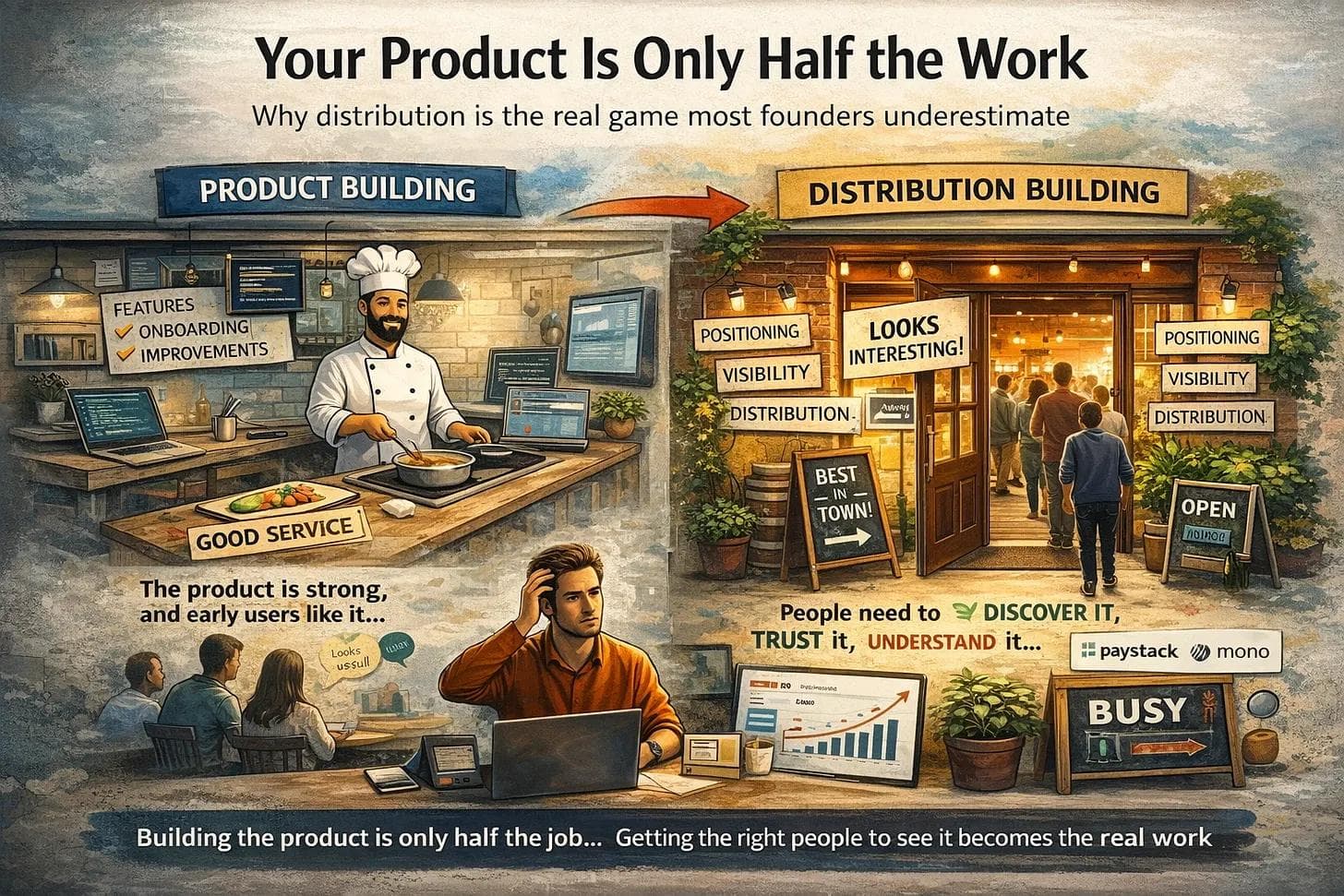
Your product is only half the work; distribution is the real game.
————————————————————————————————-
This Newsletter is brought to you by
Running a business is already demanding. The last thing you should worry about is how to receive payments or track your transactions. Nearpays makes this easier by giving businesses a simple way to accept payments, monitor transactions in real time, and manage their financial activity from one platform.
For founders and growing businesses, convenience and reliability matter. With Nearpays, you can focus more on serving customers and growing your business while your payment system works quietly in the background. If you’re looking for a smarter and more efficient way to handle payments, Nearpays is definitely worth exploring.
There’s a confusing stage many founders reach.
The product is working.
Users who try it like it.
The experience is smooth enough that people don’t complain much.
Yet growth still feels slow.
Signups trickle in.
Revenue moves, but cautiously.
Momentum feels fragile.
And when founders find themselves here, the instinct is almost always the same.
They return to the product.
Maybe onboarding needs to be smoother.
Maybe users need another feature.
Maybe the interface still needs polishing.
So the founder goes back into build mode.
Because building feels productive. It feels like forward motion.
But sometimes the real problem is not what you are building.
It is whether the right people ever see it.
One of the hardest realizations in building is this:
A good product does not automatically become a visible product.
In the early days, founders are focused on solving the problem well. They want the experience to be right. They want the product to actually work.
But once the product reaches a point where it delivers value, another challenge quietly appears.
Discovery.
Who knows this product exists?
Where do the right users encounter it?
Why should they pay attention to it now?
These questions sit outside the product itself, yet they determine whether the product grows or stays hidden.
You can build something genuinely useful and still struggle if there is no deliberate path between the product and the people who need it.
And this is where distribution begins to matter.
You can see this dynamic clearly in the Nigerian tech ecosystem.
Take Paystack.
When Paystack started, online payments were not a completely new concept. Businesses already knew they needed ways to accept payments online.
But what Paystack did exceptionally well was making itself visible and understandable to the people who needed it most: developers and startups.
They invested heavily in clear documentation, educational content, and community engagement within the startup ecosystem. Developers found it easy to integrate, founders heard about it through other founders, and gradually the product became the obvious choice for many businesses building online services.
The technology mattered, of course.
But what truly accelerated Paystack’s growth was the way the company positioned itself within the communities that needed it.
The product solved the problem.
Distribution made it the default.
Many founders begin their journey as builders.
They know how to design systems.
They know how to write code.
They know how to create a product that works.
Distribution feels like a different world.
It requires thinking about audiences, communication, channels, partnerships, and attention. It requires stepping outside the product and understanding where your potential users already spend their time.
For many builders, this feels unfamiliar.
So they postpone it.
They convince themselves that once the product becomes “good enough,” people will naturally discover it.
But discovery rarely happens by accident.
It happens through intentional distribution.
Another good example comes from Mono, a company that builds infrastructure allowing businesses to securely access financial data from banks.
Infrastructure products like Mono solve very real and important problems. But their users, developers, and fintech companies need more than just a functional product.
They need to know it exists.
They need to trust it.
They need to understand how to use it.
Mono didn’t just build the technology. They invested in developer documentation, ecosystem relationships, and visibility among the companies that could benefit from their tools.
The product enabled the solution.
Distribution enabled adoption.
Without that second layer of work, even a strong infrastructure product could remain unnoticed.
In the early stages of building, most founders focus entirely on the recipe.
Does the product solve the problem?
Does it work reliably?
Do users get value from it?
But eventually another question becomes unavoidable.
How do people actually find this?
You can cook the best meal in the world, but if your restaurant is hidden in a quiet alley with no sign outside, very few people will ever taste it.
The food matters.
But so does the path that leads people to the door.
If you are currently in a phase where the product works but growth feels slower than expected, it may be worth asking yourself a different question.
Not “What else should we build?”
But rather
How are the right people discovering what we’ve already built?
Because at some point in every startup journey, building the product stops being the hardest part.
Getting people to see it becomes the real work.
And that’s the part many founders underestimate.
If this reflects where you are in your journey right now, I’d love to hear from you.
Are you still focused on improving the product?
Or have you started focusing on how the right people discover it?
Reply to this mail and tell me.
See you in the next episode.
Until then, keep learning and keep building.
Category
Founder's Kitchen