Loading blogs...

By David A. Newdawn
15th June, 2026
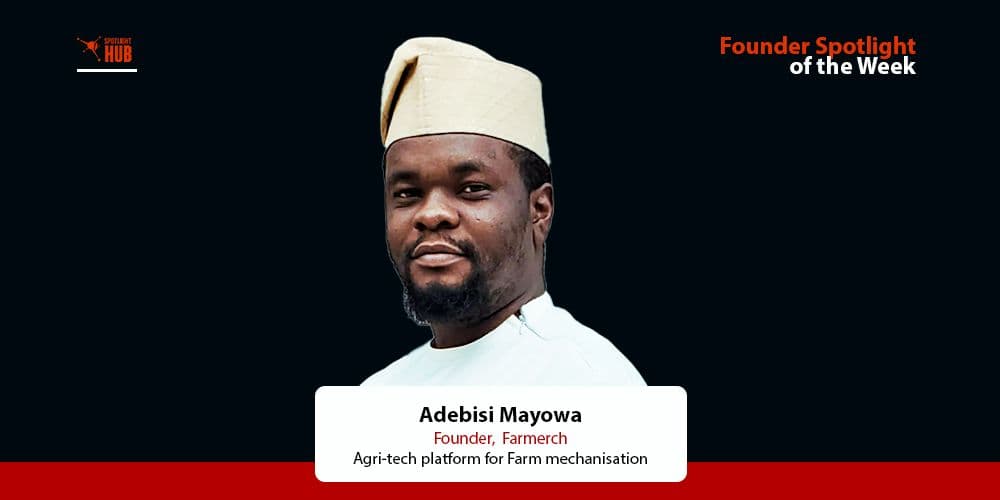
Hello Builder, In our recent Founders’ Journey interview conversation, we engaged with Mr. Mayowa Adebisi, the Co-Founder and CEO of Farmerch, to discuss his journey from aspiring aeronautical engineer to agritech founder.
What unfolded was a masterclass in resilience, strategic pivoting, and the unglamorous reality of building in Nigeria’s agricultural mechanization space.
The Spotlighthub:
Mayowa, you run Farmerch, which provides mechanization services to farmers across Nigeria. But I understand your original dream was quite different.
Oluwamayowa Adebisi:
Yes, actually. Like every one of us, we all had different childhood dreams. I started wanting to become an aeronautical engineer. In fact, I tried doing LSATs and all before one of my father’s friends convinced my dad that I should stay back in Nigeria to study something else.
My dad had always been a timber contractor; he had tractors and vehicles for moving timber. My grandparents were also into agriculture and had their farms. So it just came naturally to study agricultural engineering. It was what I selected after writing my JAMB. I’d always known I would be in the agricultural engineering space.
“I started wanting to become an aeronautical engineer, but agriculture just came naturally.”
TheSpotlighthub:
So how did you transition from studying agricultural engineering to actually founding Farmerch?
Mayowa Adebisi:
2013 was my first exposure to the agricultural engineering space in terms of practicals. I took my internship after the 300 level, with Prof. G. A. Makanjuola in Ilesha. That was the beginning of the journey.
After that, I interned and freelanced at the National Center for Agricultural Mechanization; we registered the company in 2020 and joined NAMEL in 2020. So I’d been in this space for close to a decade before starting Farmerch.
“I’d been in the agric space for close to a decade before we registered the company in 2020.”
TheSpotlighthub:
Starting is one thing, but continuing is another. What were some of the major challenges you faced?
Mayowa Adebisi:
Starting was not really a problem. You know, you can start anything. It’s continuation that matters.
One of the major issues early on was that you’d get a project, get people to go handle the project, and then at the end of the day, they’d just collect your money and disappear.
I had to start paying some of those clients with my own allowances. I took projects, the people messed up, and I ended up using my allowance to pay clients back to avoid trouble.
“Starting was not really a problem. You can start anything. It’s continuation that matters.”
TheSpotlighthub:
That must have been incredibly frustrating. How did you push past that?
Mayowa Adebisi:
I started with two of my friends, Opẹ Talabi, who studied computer engineering, and Samuel, who studied accounting management. The first client we had was the former SSG of Cross River State. She trusted us with 400,000 naira to do operations.
After collecting the money, we couldn’t get tractors to do the job. So we had to refund the money. That was one of the major challenges.
But here’s what kept us going: in 2023, I resigned fully to focus on this. We had gathered some money, bought machinery, and had contracts with two major agritech companies.
“The first client trusted us with 400,000 naira. We couldn’t get tractors, so we had to refund the money.”
TheSpotlighthub:
Tell us about that 2023 contract. What happened?
Mayowa Adebisi:
When we got our first contract and second contract in October 2023, we had issues getting machines to deliver. We needed 40 machines but couldn’t get them. So we decided, let’s start with three. We needed money to buy three, but there was no money. We rallied around and got money for one.
Then I sent a random message to my mentor; he’s the group CEO of one of the agritech companies. I told him, “This is how we got this contract, and this is the issue we’re having. We don’t know what to do.”
He asked how he could help, and I explained what we needed. He said, “Okay, I’ll support you. Send me timesheets on how you intend to pay back.”
He supported us with some money, and we were able to get three machines and deploy to sites.
“Don’t be afraid to reach out for help when you’re stuck. Send that message. Make that call. Sometimes a simple, honest conversation about your challenges can save your entire business.”
TheSpotlighthub:
But it didn’t go smoothly, did it?
Mayowa Adebisi:
By the time we bought the three machines, agriculture being seasonal, the market had already gone down. We went to Kaduna with language barriers.
The contract was signed with organizations whose agents were supposed to be available to take us around, leveraging their network of extension agents and warehouses. But by the time we got into the market, most farmers had already invested elsewhere.
We had spent over two million naira ensuring we kickstarted, and at the end of the day, we made 11,500 naira.
TheSpotlighthub: 11,500 naira after spending over two million?
Mayowa Adebisi: Yes. It was really tough. I had put all my savings into this, and I was literally broke. That was December 2023, and everything just went wrong.
“We spent over two million naira kickstarting. At the end of the day, we made 11,500 naira.”
TheSpotlighthub:
How did you recover from that?
Mayowa Adebisi:
In 2024, I was struggling. I had this consulting gig where I was consulting for a major agritech company, so I used that to hold myself and put some funding together. Then clients reached out, ”Come and do this for us.” I thought, “Oh, this is it!”
I used all the savings I had to get machines and operators, just to ensure we delivered top-notch services. After doing all that processing and spending about 80-90% of my entire savings, the client, a major client who runs a startup that got into YC earlier, just called me and said he spoke with his partner, and his partner said she doesn’t think they should go ahead with the project.
I wanted to go mad because it really got to me. I was back to square one with zero funds in my pocket and nothing to show for it.
“I spent 80-90% of my savings preparing. Then the client’s partner said they shouldn’t go ahead. I was back to square one.”
TheSpotlighthub:
That’s devastating. What happened next?
Mayowa Adebisi:
There was this client we’d been pursuing since April; we had like 20 back-and-forths on the contract. We had already spoken to a major tractor owner who promised, “Don’t worry, I’ll give you eight machines to do your job.”
The client finally paid in June. The tractor owner had given us a quote, let’s say 20,000 naira per hectare. Based on that, we calculated everything, put it into the budget, and gave the client a quote. After the client made payment and we made deposits into the tractor owner’s account, I saw an email: the tractor owner said they should return our money.
TheSpotlighthub:
After you’d already committed to the client?
Mayowa Adebisi:
Exactly. The client had already paid. We had the money, but there was no machine. I had already promised the client 72 hours after payment that we’d get the machines delivered.
According to our plans, it should have been 14,000 maximum to deliver the machines. But now the tractor owner was saying she’s not going to give us tractors, so it became a whole new problem.
“The client paid. We had the money but no machines. The tractor owner withdrew at the last minute.”
TheSpotighthub:
How did you solve that crisis?
Mayowa Adebisi:
There was a person who’d been telling us he wanted to give us his machines, but the conditions were quite expensive. I had to call him. Luckily, while I was eating pounded yam and just trying to forget my sorrow that morning, this other person called: “Mayowa, are you still interested in the tractors?”
I said, “Yes! In fact, I need it at all costs right now.”
He saw the desperation and decided to help.
What was initially 20,000 naira per hectare became 45-50,000 naira per hectare. We were paying way more than what we’d planned for the services. We just paid to start the project and figured we’d work it out along the way.
Then, two days after we started operations, the price of diesel, which was 287 naira per liter, suddenly went to 800-900 naira per liter. Everything that could go wrong just totally went wrong.
“The price of diesel jumped from 287 to 800-900 naira. Everything that could go wrong went wrong.”
TheSpotlighthub:
Grace, you had a question about the team?
Grace Amusan:
Yes! You mentioned you have a team, two people, one from computer engineering and one from accounting. There’s a big gap between agriculture and those fields. How did you convince them to join, and are they still with you after all these challenges?
Mayowa Adebisi:
They were my friends from school. The accounting guy was my roommate, and the computer engineering guy was my faculty mate. We just survived OAU together. After the whole thing, I just told them, “Guys, let’s do this.” They were like, “Okay, what’s it going to be? What’s the equity like?”
I said, “Let’s just do this and make some money off it.” They were excited because they knew that when I want to be serious about things, I can be serious. They’d seen me in the agric space for a while, so they knew I had the capacity to pull things off. They were just like, “Okay, let us support our friend.”
“My friends knew when I want to be serious, I can be serious. They trusted me and decided to support.”
TheSpotlighthub:
And they’re still with you?
Mayowa Adebisi:
Yes! That first contract we took in 2020 or 2021, from the former SSG, gave us the courage to start. The fact that somebody could pay for it convinced my friends and myself that this is something that can go far.
Sammy is still fully part of the team. We have weekly standups. He’s been there through thick and thin, following up on finances and operations. Opẹ is fully active too, he helps us manage our resources. Instead of investing millions to build an app, for example, Opẹ advises, “You can use simple and free no-code tools.”
He’s more of a consultant, and on the project we’re currently working on, he’s been fully involved.
So all parties are still involved.
“Sammy and Opẹ are still fully involved. We have weekly standups. They’ve been there through thick and thin.”
TheSpotlighthub:
Do you have competitors? How do you manage against bigger, more established companies?
Mayowa Adebisi:
We have big competitors. But one of the things that gave us an advantage is that I’d been in this space before. I’d worked at Makstech, the National Center for Agricultural Mechanization.
I also worked as a consultant for a major agritech company currently active in about three or four countries in Africa.
What gave us access to the market was that most of the people I was talking to had already known me in the industry. They are aware of what Mayowa was doing, and I can largely attribute our success to hard work and favor.
There were projects to show that Mayowa can deliver. So there’s a track record of Mayowa as a person. Now Mayowa speaking to clients as the CEO of an organization, even though it’s just starting, was easy.
“Most clients already knew me in the industry. There was a track record. That made it easy.”
TheSpotlighthub:
So your personal brand opened doors?
Mayowa Adebisi:
Yes. And we try as much as possible to move under the radar. Most of the jobs we’ve taken have been based on word of mouth. Until late last year, you wouldn’t even see us on social media.
We’ve been trying to move away from their radar. We’ve been operating in places where they are not. And considering the agricultural space mechanization, it’s a very big space. Even if there are five more organizations like us, it will still be enough for everybody.
And another thing, it’s a very difficult space. The challenges I told you about are like the barest minimum. There are other stories I cannot tell now because we’re not there yet, but we will get there.
“We’ve been moving under the radar, operating where the big boys are not. The space is big enough for everyone.”
TheSpotlighthub:
Let’s talk about the tech side. What impact has technology had on your operations?
Mayowa Adebisi:
In 2023, we didn’t use any tech. It was just cash on delivery. The planning was poor, we just wanted to start. That’s why at the beginning of this interview, I said starting is not really a problem. Sustaining the business is the problem.
In 2024, everything was manual. The operations manager sent reports through WhatsApp and all. So late last year, we decided we need to use tech to solve these issues.
We started using Google Sheets to take real-time reports from the field. Those real-time reports were automatically converted to a dashboard. We built a different dashboard for every client. So as a client, without having to call us, by the time you check the link we sent, you can easily access the data, how many hectares have been done per time, which area the hectares have been done.
“We use Google Sheets for real-time field reports, automatically converted to client dashboards. No more confusion.”
TheSpotlighthub:
How has that helped?
Mayowa Adebisi:
It’s really been helpful. There’s no Backnforth (Kalokabo). The client is seeing five hectares, ten hectares, twenty hectares per day. Our tractor owners are also seeing, “Okay, how many hectares has my tractor done? Twenty hectares, fifteen hectares.”
It’s not difficult for their operators to cheat them because operators do cheat. Because our jobs are contiguous and the next farmer is already waiting before the tractor operator finishes the farm, it’s difficult for operators to cheat the tractor owners. So tractor owners are enjoying that benefit right now.
TheSpotlighthub:
This sounds like it evolved into something bigger?
Mayowa Adebisi:
Yes! One tractor owner had issues this year. In June, we’d already paid him like 28 million naira for the year. Then he said, “I don’t think so, you people have only paid me 24.5 million.” Because we’re an organization that takes records, we sent him the receipts and everything. He was like, “Ah, I did not know!” He’d just been collecting money and spending it.
He then asked us: in addition to reports on how many hectares his tractors have done, could we include their cash flow, how much they’re supposed to collect, how much they’ve collected, the balance, and stuff like that
That’s what led to the business management tool for mechanization service providers (MSPs) that we’re currently building.
“A tractor owner didn’t realize we’d paid him 28 million naira. That led us to build a financial management tool as MSP”
TheSpotlighthub:
Tell us more about this tool you’re building.
Mayowa Adebisi:
Our MVP toolhase instant access to how many hectares they’ve done and how much they’ve made. Based on the data we’ve collected, we’re currently working with some financial institutions to help the tractor owners who’ve been working with us get access to financing.
Getting access to financing has been one of the major issues people in the agriculture space have always faced. But because we help them track their finances, think of it like an app, we now have access to that data, and we have a growing network of customers.
“We’re building something like Moove, but for mechanization service providers.”
Thespotlighthub:
So you’re helping them scale their businesses?
Mayowa Adebisi:
Exactly. This year we did about 2,000 hectares of farmland altogether, and even at that, we were unable to meet demand. We’re looking for ways to increase our fleet.
For example, that man who made 28 million naira by working with us, we have his record and everything. We could help him present that to a bank so he can get financing to buy another tractor.
So we’re no longer just in the business of helping farmers have access to affordable and reliable mechanization. Now we’re helping mechanization service providers, the tractor owners, grow their businesses profitably and sustainably.
They can track their finances, budget properly, keep records to present to financial institutions. We’re building Moove, but for mechanization service providers.
“Now we’re helping tractor owners track finances and access funding to grow their businesses sustainably.”
TheSpotlighthub:
What role does government play in all this?
Mayowa Adebisi:
The government’s support actually goes a long way. For example, we recently launched a farm management estate product where we list a pool of land, let’s say 50 hectares for starters. People who are looking to get into the agric space but don’t know much about agriculture can subscribe to that.
We’re only doing this because we have government support. The Ekiti state government has really been very supportive of agriculture. The commissioner, Ebenezer Aboluade, is a fantastic and very intelligent man. His excellency, Biodun Oyebanji, has really been supportive.
Last year and this year, they provided 50% subsidy for mechanization services for all farmers within the state. If you have land in the state that needs clearing, the state government will do it for you for free. They’ve empowered a lot of youths through their “Youth in Agriculture, Back to Agriculture” program.
“The Ekiti state government provides 50% subsidy for mechanization. Without government support, we wouldn’t consider farm estates.”
TheSpotlighthub:
So government support is essential?
Mayowa Adebisi:
Without the government, I can assure you things will be very difficult. If the government is not supporting what you’re doing and they come up with a policy tomorrow, you could run into total losses. That’s what happened with some rice farmers when food prices crashed this year.
The government is a very important part of growth in the agricultural sector.
“Without government support, I can assure you things will be very, very difficult in agriculture.”
TheSpotlighthub:
For people looking to solve problems in agriculture with tech backgrounds, what’s your advice?
Mayowa Adebisi:
I can’t really say there’s a roadmap or guide, but the first thing is you need to be involved. You need to understand agriculture itself. That only happens when you’re actively involved and experience it yourself.
For example, I used to do engineering design when I was in school; I used Autodesk Inventor. That was giving me some good money. The last job I took in 500 level was 200K.
During my service, I was posted to ministry of Agriculture and Natural resources in Ebonyi state. But after my service, I stayed back to learn rice production with an allowance of 20,000 naira per month, even without NYSC allowance. That’s because I wanted to learn the entire production chain of products.
“You need to be involved. You need to understand agriculture itself by experiencing it yourself.”
TheSpotlighthub:
So hands-on experience is critical?
Mayowa Adebisi:
Yes. The primary route is getting involved yourself. For example, in this farm management, we are working on giving access to people to own the land and registration will be opened to people in January.
You can bring your friends together, ten of you can come together to take your plots. That will help you understand what’s actually going on without starting everything from scratch.
The beauty is you can leverage existing networks. We are here today because we’ve been able to leverage existing infrastructure, Agritech companies, state government. All these have given us wings to fly. We’ve been given the opportunity to walk without necessarily scratching our heads from zero.
The secondary route is talking to people like me, people who have been in this space for a while. We can help you look at your processes and issues.
“Leverage existing networks. We’re here because we leveraged Agritech companies, and state government infrastructure.”
TheSpotlighthub:
What skills would you recommend?
Mayowa Adebisi:
When I had issues with the software developer, Opẹ introduced me and explained the basics of getting involved in tech. I think as an agriculturist, one of the best skills you can have to infuse tech into agriculture is being a product manager.
If you’re a product manager, you know how to relate to the product designer, the software developer. It’s easier for you to manage things and know what to do next. I took a course in growth product management, it combined data analysis, marketing, and product management. I’d already taken courses on becoming a product manager too.
So data analysis and product management, if you were to ask me, are the major skills that will help you infuse tech into agriculture.
“Product management is one of the best skills for infusing tech into agriculture. You need to know how to relate to designers and developers.”
TheSpotlighthub:
How do you measure success at different stages?
Mayowa Adebisi:
Success varies at different points in time. In 2023 when we started, success for us was, “Oh, we were able to get a contract.” Even after getting the contract, success was, “Oh, we’re able to kickstart the project.”
In 2024, success was, “Oh, we’ve been able to deliver X number of clients. This is the number of hectares we’ve serviced, this is how much we’ve generated in revenue.” We’re not really concerned about profit margin yet, just about getting things done.
This coming year, our success is: What is our profit margin? How many farmers have we helped? How many smallholder farmers have gone from cultivating two hectares to now cultivating five or ten hectares? Success for us is a tractor owner that used to make one million naira in a year now making two million.
“Success varies by stage. Now it’s about commercial excellence for every stakeholder, farmers, tractor owners, and us.”
TheSpotlighthub:
So it’s about ecosystem growth?
Mayowa Adebisi:
Exactly. Right now, it’s more about commercial excellence and profitability and sustainability of the business for every stakeholder, the farmers, the tractor owners, and ourselves.
TheSpotlighthub:
Where do you see Farm Merch in the next five to ten years?
Mayowa Adebisi:
In the next five to ten years, we want to be Africa’s leading platform for data-driven mechanization and farm management services. We want to be present in about ten countries. We want to say we’ve impacted over 100,000 farmers in Africa.
I want to be able to say we’ve helped Nigeria increase the capacity of farmers within our network from an average of two hectares to five hectares. We’ve been able to help tractor owners and mechanization service providers within our circle increase their fleet of machines from one to three or more, thereby ensuring that more people have access to better and more reliable mechanization services.
“In ten years, we want to be Africa’s leading platform for data-driven mechanization, impacting 100,000+ farmers across 10 countries.”
TheSpotlighthub:
If you could go back and change one thing about your journey, what would it be?
Mayowa Adebisi:
Looking back now, I don’t think I would have changed anything. My journey’s trajectory was that I spent ample time working for other people, at NCAM, NAMEL, and others—before starting my own organization. We just started, and we’re finding our feet along the way. I had access to mentors, people who, if there were issues, I could easily call.
All those experiences prepared me for this. I wouldn’t change anything.
“I don’t think I would have changed anything. Every experience prepared me for this.”
Grace Amusan:
How do you balance being a founder with your personal life?
Mayowa Adebisi:
I wouldn’t lie to you. As a startup founder, somebody coming into the space, you really cannot say you have your life planned out. This is from my personal experience a lot of people may think otherwise.
You could have planned that tomorrow you want to be somewhere, you want to do this, you want to do that. Then a client calls that you really need to be here, or one of your people has issues on the field, or there’s communal clash at an operation site, or you have an issue with a client.
At every point in time, you need to prioritize what matters. You can have a plan, but at the back of your mind, you should know something can change it. It’s a startup, anything can go wrong. Things you’ve not even envisaged before.
That’s why having mentors who’ve been in this space before is very important. When things happen, instead of panicking, they’ve been through it before. They’ll help you navigate and tell you, “Instead of doing this, do this instead.”
“As a startup founder, you really cannot plan your life like that. At every point, you need to prioritize what matters.”
On Starting vs. Sustaining:
“Starting was not really a problem. You can start anything. It’s continuation that matters.”
On Financial Struggles:
“We spent over two million naira kickstarting operations. At the end of the day, we made 11,500 naira. It was really tough.”
On Leverage: “We’re here today because we leveraged existing infrastructure, Agritech companies, state government. They gave us wings to fly.”
On Tech in Agriculture: “In 2023, we didn’t use any tech, just cash on delivery. The planning was poor. Sustaining the business is the problem.”
On Government Support: “Without the government, I can assure you things will be very, very difficult in agriculture.”
On Essential Skills: “Product management and data analysis are the major skills that will help you infuse tech into agriculture.”
On Team Loyalty: “My friends knew when I want to be serious, I can be serious. They trusted me and stayed through thick and thin.”
Mayowa Adebisi’s journey is a testament to resilience in the face of impossible odds. From refunding his first client to nearly going broke multiple times, to building a platform that’s transforming agricultural mechanization in Nigeria. His story reminds us that the path to success is rarely linear, and sometimes the biggest wins come after the most devastating losses.
Find Farmerch on LinkedIn and learn more about their mechanization services and MSP management platform.
It is obvious you are tired of failed international transactions or payments that get delayed like a delivery bike that got stucked in Lagos traffic. This is 2025 and Nearpays is solving the problem that address your need, no more frustration with international transaction.
————————————————————————————————-
Nearpays have decided to put a smile on the face of every founder, enterpreneur, trader, Freelancer and business owner by rolling out the Nearpays FX feature that allows you to transact in USD, and you have access to own a Dollar card to make subscription and other payment in USD.
Register with Nearpays now to give you the access to experience smooth international transaction and payment.

The Spotlighthub celebrates founder stories across all sectors, from tech to agriculture to community building. We believe every field needs innovative founders willing to solve hard problems. If you have a story to share or know someone who does, reach out to us at Spotlighthub001@gmail.com
Until the next episode
Keep learning, keep building.
Thank you.
Category
Founder's Spotlight