Loading blogs...

By David A. Newdawn
15th June, 2026
In many parts of Lagos, waste is not something you think about until it becomes impossible to ignore.
It gathers in corners, clogs drainage systems, spills into the streets, and quietly shapes the environment people live in every day. For most, it is just a byproduct of daily life. Something to manage, avoid, or complain about. But for Amidu Mohammed Dabban, it was something else entirely.
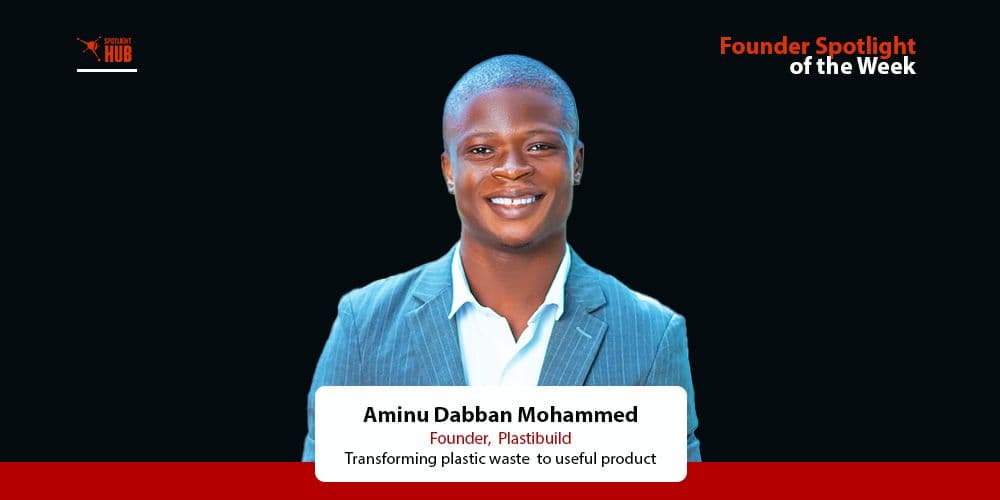
In our recent Founder’s Journey conversation, we had the privilege of hosting Mohammed Amidu, founder of Plastibuild, a climate-tech and sustainable manufacturing company transforming waste into value through circular innovation, green technologies, and community empowerment across Africa.
Growing up in Bariga, he didn’t encounter waste as an abstract environmental issue. It was physical, visible, and constant. But beyond the environmental problem, there was also something more immediate, a practical, everyday challenge that people rarely paid attention to.
“I grew up in Bariga, and one of the things I noticed was not just the waste problem, but even something as simple as footwear,” he explains. “People didn’t have durable slippers, and it affected how they moved around, especially in rough environments.”
That observation led to his earliest experiment, not a startup, not a company, but an attempt to solve something small and real. He began working with discarded tyres, repurposing them into slipper soles that could last longer and withstand the environment people lived in.
It was simple. But it worked.
And more importantly, it changed how he saw waste.
What started with tires expanded into broader material exploration, plastics, composites, and different forms of waste that could be repurposed into something functional. The curiosity deepened, and so did the ambition.
“Waste doesn’t really exist,” Amidu says. “It’s just resources in the wrong place and at the wrong time.”
That philosophy became the foundation of what would eventually become PlastiBuild Africa, not just as a recycling effort but as a system for converting waste into economic opportunity.
From slippers, the work expanded into plastic bricks, green furniture, and other upcycled products. Each iteration was not just about creating something new but about proving a point: that materials people throw away still hold value when placed in the right context.

It was about creating an ecosystem.
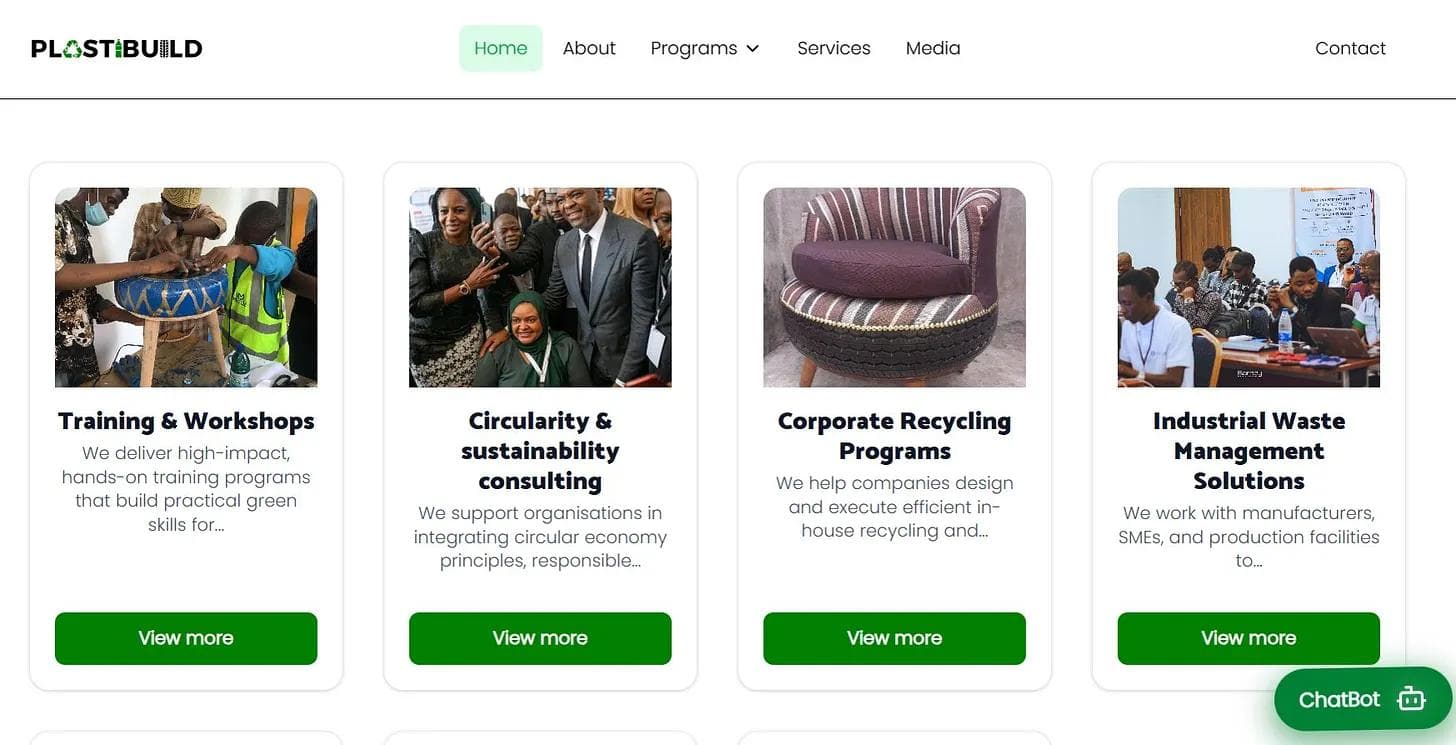
That realization led to one of the most defining steps in the company’s journey, the creation of a digital waste upcycling hub & makerspace, a shared environment where individuals could access tools, training, and systems to convert waste into usable products.
“We didn’t want to just build products ourselves,” Amidu explains. “We wanted to create a space where other people can come in, learn, and also build.”
The makerspace operates with intention. People don’t just walk in with materials; there’s a process. Conversations happen first. The type of waste is assessed. Possibilities are explored. Costs are understood. Only then does the creation begin.
It is not just a workspace.
It is a system of co-creation.
And through that system, PlastiBuild Africa extends its impact beyond its internal team, enabling others to participate in the process of turning waste into value.
Like most ambitious builds, the journey has not been without its challenges.
One of the most defining factors has been financials.
“The major challenge is funding,” Amidu says plainly. “You have to learn how to manage what you have, and more importantly, invest in yourself.”
For him, building credibility became part of the strategy. He invested in education, training, and global exposure, from climate innovation programs to advanced studies in environmental sustainability, not just for personal growth but to strengthen the foundation of the company.
“Investors don’t just invest in the idea,” he adds. “They invest in the founder first.”
That mindset shaped how he approached growth. Rather than chasing quick funding, he focused on building capacity, forming partnerships, and positioning the company for long-term sustainability.
Unlike the idealized version of startup teams, Amidu speaks about it with clarity and honesty.
“Your team is not permanent,” he says. “People will join, and people will leave. You have to keep communicating the vision and keep building.”
At PlastiBuild Africa, recruitment is not a one-time event. It is continuous. The vision has to be repeated, re-explained, and re-sold not just to new people but even to those already within the system.
It is an ongoing process of alignment.
Growth, for Plastibuild, has also been driven by collaboration rather than competition.
“We don’t really see others in this space as competitors,” Amidu explains. “We see them as collaborators, because the problem is too big for one organization to solve.”
That mindset has shaped how the company operates, working with artisans, designers, universities, Rotary Clubs, and government institutions. These partnerships have not only expanded reach but also grounded the work in real communities.
“We didn’t start with big marketing,” he says. “People saw the products, someone wearing them, exhibitions, and social media, and that’s how the first customers came.”
It was visibility through use.
Proof through presence.
One of the most defining moments in the journey came with the launch of the DigiHub, a key milestone in PlastiBuild Africa’s infrastructure.
But even that moment came with its own setback.
“The DigiHub actually collapsed during a rainstorm last year,” Amidu recalls. “But we rebuilt it.”
The rebuild marked more than recovery. It represented resilience, the ability to continue building even when progress is interrupted. With the Hub now officially launched, Plastibuild has moved into its next phase: expansion.
The goal is clear to replicate the model across multiple cities, including Kano, Abuja, Aba, and Ilorin within the next 24 months.
At its core, PlastiBuild Africa is driven by a long-term vision that extends far beyond its current operations.
“In the next five years, we want to be one of the leading climate-tech startups in Africa,” Amidu says. “And in ten years, we’re building towards becoming Africa’s first circular economy unicorn.”
It is an ambitious vision. But like everything else in the journey, it is grounded in a pattern: start small, test, build, and expand.
There is a quiet consistency in how Amidu approaches building.
It is not driven by urgency alone but by understanding.
Understanding the problem.
Understanding the system.
Understanding the people involved.
And perhaps most importantly, understanding that what looks like waste to one person can become an opportunity for another if someone is willing to see it differently and build around it.
TheSpotlighthub
Category
Founder's Spotlight