Loading blogs...

By David Newdawn
6th October, 2026
Every startup has a story.
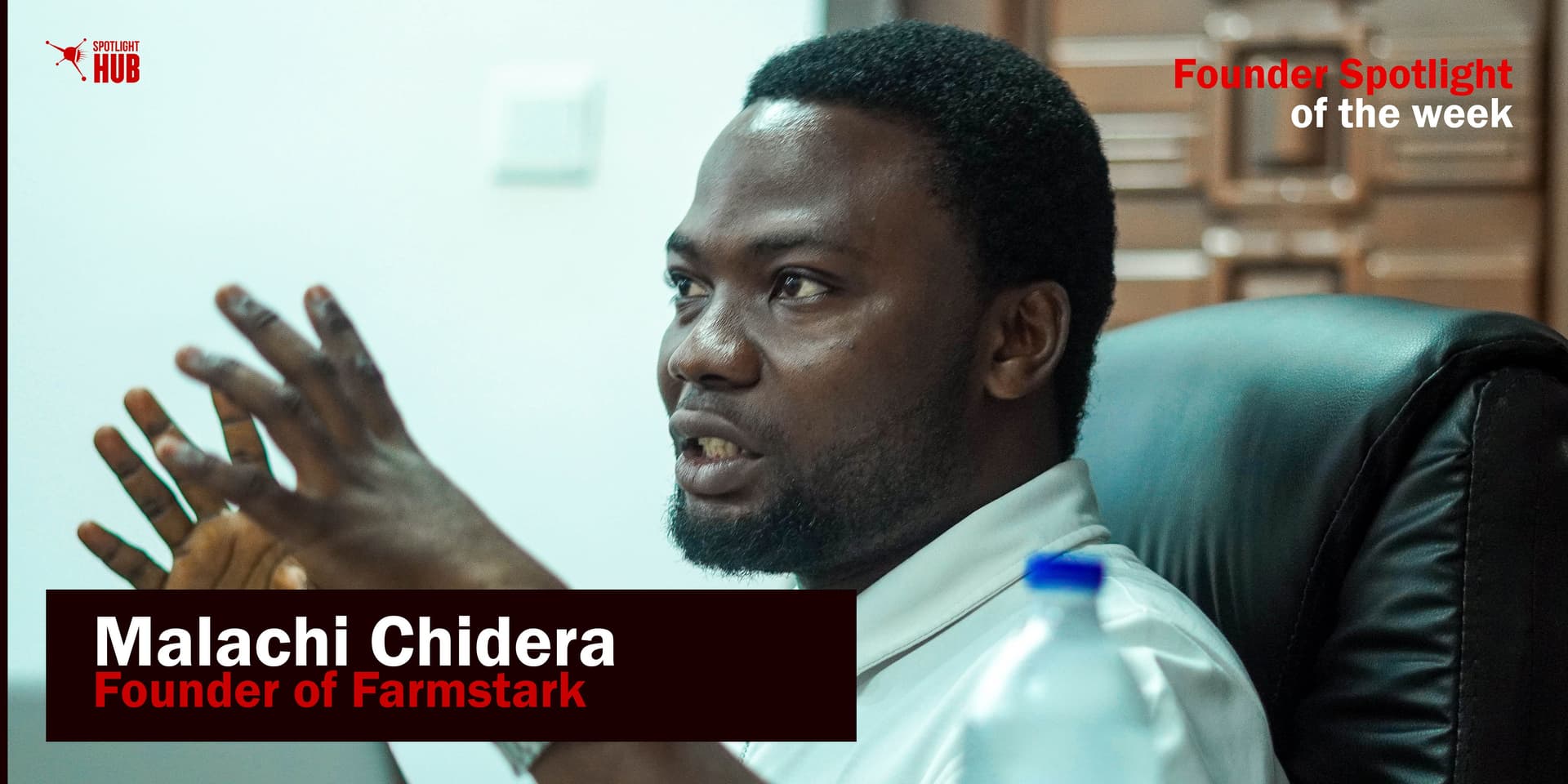
For Malachi Chidera, Farmstarck started with something very personal: watching his mother struggle to sell agricultural commodities.
What began with a phone call from his Mother about how to sell 25 tons of cassava eventually became a much bigger idea around food access, procurement, logistics, agriculture and technology.
In this edition of Founders Journey, Malachi shares how Farmstarck started, what he has learned from building, why visibility matters, and why founders should stop waiting for everything to be perfect.
Let’s dive in
Malachi: My mum has been farming for over 25 years, and I grew up seeing the challenges she faced.
The problem was not just farming. After producing the commodities, how do you sell them? How do you get the right buyers? How do you move them from one place to another? How do you make sure that middlemen don’t take almost all the profit?
At some point, she called me about 25 tons of cassava that she needed to sell. I started researching and talking to people, and I discovered that there was actually a huge demand.
That was when I started looking at agriculture differently.
Between August 2025 and February 2026, we were able to process over $100,000 in transactions and make about $13,000 in net profit, completely bootstrapped.
That was really how Farmstarck started.
Malachi: Farmstarck has grown beyond just selling food.
We are building an agricultural marketplace where you can find anything agriculture related, from raw, processed and fresh commodities to livestock, chemicals, farm equipment, machinery, kitchen equipment and food products.
We also have what we call Food Vault.
You can start saving for food ahead of time. Maybe you want to prepare for Christmas, a wedding or another celebration. You can start saving from January, and family and friends can contribute to your Food Vault as well.
At the end, you can use the money to buy what you need at a discounted price.
Then we looked at businesses.
Restaurants and food businesses need
to constantly manage inventory, but getting reliable suppliers can be difficult. So we are building a procurement and inventory management system where businesses can manage what they are buying and track their stock from one dashboard.
We also looked at content creators.
There are agricultural creators with thousands and even millions of followers, but there are not enough ways for them to properly monetize their audience.
So we created a system where creators can tag agricultural products in their content. Someone watching the content can click to buy the products, and the creator can earn up to 30% of the revenue.
Malachi: The platform is AI powered.
We are building a chatbot that helps people make informed decisions about food. For example, if you have certain dietary needs, you can interact with the AI and get recommendations on the kind of food or commodities that may be suitable for you.
We are also looking at things like uploading results and using that information to make better recommendations. And if the commodity you need is not currently available on the platform, we can source it for you.
So eventually, you can see something online, learn how to prepare it, get the ingredients and buy everything you need in one connected experience.
Malachi: Trust is the highest currency. My mum taught me a lot about agriculture, but one of the biggest things I learned from her is that you have to be trustworthy.
Don’t break the trust people place in you.
I’ve had people give me significant amounts of money to handle transactions for them, even at times when I was personally going through financial challenges.
That tells you something about relationships.
People may forget what you said, but they don’t forget how you made them feel about trusting you.
That’s something I carry into Farmstack.
Malachi: I’ve had opportunities to leave Nigeria.
But I believe there is still so much to build here.
The problem is that sometimes we look at agriculture as just farming or food. Agriculture is much bigger than that.
There are things happening in this sector that people outside it don’t even realise.
The vision for Farmstarck is to go beyond Nigeria and eventually tap into other African markets, make cross-border trade easier and reduce the friction around food access.
We also want to explore things like integrating with HR systems so employees can access food and pay for it gradually from their salaries.
The vision is massive.
We just want to democratize food access and make the entire system easier for both farmers and consumers.
Malachi: Before Farmstack, I was already building in tech.
I co-founded Cypher, a project management company, and we eventually decided to build our own product.
It was a crypto payment gateway and exchange solution. We expanded into different countries and processed about $4 million in transactions.
Then crypto regulation affected the business, and we also had internal challenges within the company.
Eventually, we had to wind down the business.
It was difficult, but it became part of my experience as a founder. And while that chapter was coming to an end, my mum called me about the 25 tons of cassava.
That call introduced me to a completely different opportunity.
Malachi: Delivery.
Honestly, delivery almost made us give up on Farmstarck.
How do you move perishable and non-perishable goods? How do you get the right logistics partners? How do you handle payments? It took us about six months to properly figure out delivery.
That experience taught me that you don’t always need to build everything yourself.
We are very heavy on partnerships now.
For example, we partnered with AAJ, which has logistics coverage across the 36 states in Nigeria. We can leverage their pickup locations instead of trying to build warehouses and logistics infrastructure everywhere ourselves.
Partnerships can help you move faster without unnecessarily carrying the entire infrastructure burden.
Malachi: I don’t think a founder has to know how to code. But you need to understand your business.
You need to know how to sell. You need to understand marketing. You need to communicate. You need to understand your finances. You need to know enough about technology, operations and even legal matters to have meaningful conversations with the people working with you.
As a founder, you are almost everything.
Sometimes you’re the CEO. Sometimes you’re the project manager. Sometimes you’re the salesperson. Sometimes you’re the person running errands.
You just have to be willing to learn enough to contribute.
Malachi: Because visibility creates opportunities.
I started posting on LinkedIn almost every day for about six months. At some point, I had grown from less than 2,000 followers to over 20,000.
I wasn’t waiting to have perfect content.
I was just putting myself out there, making videos, sharing what I was learning and talking about what I was building.
We also did something similar with Farmstarck.
One of our posts got over 8,000 views, brought people into our community, generated comments and helped us get signups.
You cannot build quietly and expect everybody to magically discover you.
You need to make yourself visible.
Malachi: Don’t waste your time trying to get everything perfect.
If you must launch, launch imperfectly and start.
There are so many things you think you have figured out until you actually launch. Then real users start showing you what is wrong.
Don’t overcomplicate it, Build something, Put it out there, Let people use it, Let them criticize it, Let them tell you what is wrong, Then go back and improve it.
You don’t have to know everything before you start. Sometimes, the clarity you’re looking for only comes after you launch.
Our first Farmstarck website looked okay to us, but we got feedback from an investor who pointed out issues with the branding, spelling and navigation.
We had very little money at the time. I think I had about ₦50,000.
We bought some food, got together with a team member and within 48 hours, we completely revamped the website.
That experience reinforced something for me.
Put something together. Launch. Let the criticism come. Revamp. Rebuild. Relaunch.
Malachi: Don’t just ask your family and friends.
Your family and friends can support you because they love you.
You need to speak to people who don’t know you.
If you speak to ten people and they tell you they need the product, and some of them are actually willing to pay for it, then you know there is something there.
For me, payment is important.
People saying, “This is a great idea” is not enough.
Let somebody who doesn’t know you put their money down.
That’s a stronger form of validation.
Malachi: I’ve learned that you have to solve the problem in front of you.
When we started Farmstarck, I wasn’t thinking about an AI powered agricultural marketplace with all these different components.
It started with my mum trying to sell 25 tons of cassava.
Then one problem led to another question.
We solved one thing, discovered another problem, and kept expanding our understanding of the market.
That’s how the vision became bigger.
So I don’t think you need to have the entire journey figured out before you start.
You need to understand the problem you’re solving, start building, listen to people and allow what you learn to shape the next version.
Every founder has a journey, and that is exactly why we built TheSpotlighthub.
We recently launched our website, creating a platform where founders can share their stories, discover opportunities, access resources, connect with the right people and find support as they build.
If you have been following our Founder’s Journey series, reading our stories or simply cheering founders on from the sidelines, we invite you to take the next step with us.
TheSpotlighthub is now live.
Visit thespotlighthub.org to explore the platform, discover founder stories, and see what we are building for the community.
Your next opportunity, connection or inspiration might be waiting there.
Remember you can always reach us on spotlighthub001@gmail.com
Catch you in the next episode. Until then - Keep Building
Category
Founder's Spotlight


