Loading blogs...

By David A
20th May, 2026
In Nigeria, agriculture is often spoken about in two ways: as an opportunity or as a struggle.
For many, it is seen as something to fall back on, not something to intentionally build within. A sector filled with potential, but weighed down by perception. Yet behind that perception lies a reality that is harder to ignore: a country that consumes more than it produces, constantly filling the gap through imports.
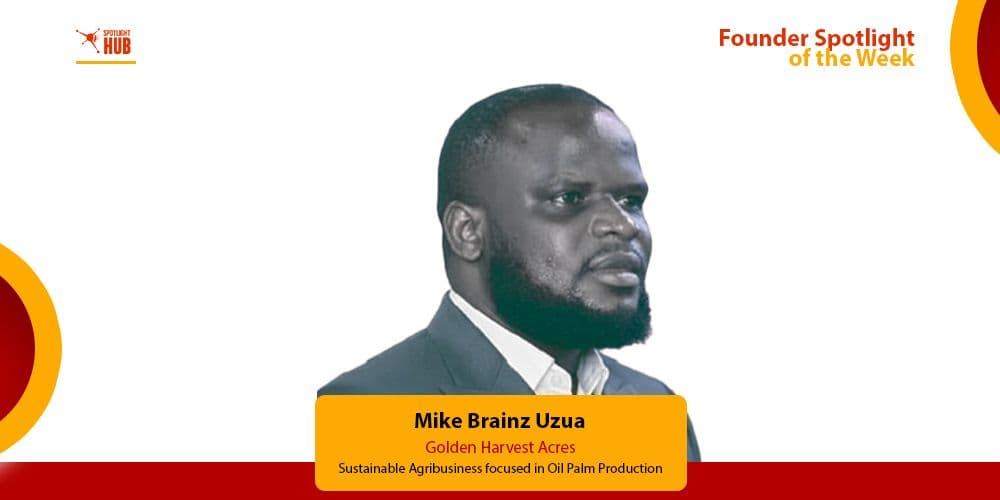
In our recent Founder’s Journey conversation, we had an interesting conversation with Mike Brainz, the founder of Golden Harvest Acres, to discover how he is redefining creating long-term wealth in the agricultural sector through oil palm production.
“I started looking into agriculture from a business perspective,” he explains. “And when I studied the palm oil industry, I realized Nigeria consumes about two million metric tons annually, but we’re not producing enough. We’re importing the produce, and that’s costing the country hundreds of millions of dollars every year.”
That realization reframed everything.
What looked like a traditional sector became a structured opportunity, one that wasn’t just about farming but about solving a supply problem at scale.
Mike’s journey into agriculture was not built on formal plantation education or inherited systems. It was built differently through observation, research, and immersion.
“I didn’t go to a plantation school,” he says. “Most of what I know came from research, visiting farms, learning directly from people already in the space, and applying it practically.”
It was a hands-on approach. One that required time, patience, and the willingness to learn outside structured systems. But it also shaped how he thinks about building grounded, practical, and rooted in understanding the field itself.
The decision to focus on oil palm was deliberate.
Not because it was easy, but because it made sense long-term.
“When you plant a palm tree, you’re not just planting for now,” Mike explains. “It’s something that can last for decades. It becomes a transgenerational asset.”
Beyond longevity, there was also the versatility of the crop. Palm oil is not a single-product system; it feeds into multiple industries, from food to cosmetics, pharmaceuticals, and even energy. Each tree produces multiple by-products, each with its own economic value.
That combination of longevity and versatility made oil palm more than a crop.
It made it infrastructure.
Not just as a farming operation, but as a full agribusiness system spanning plantation development, processing of primary palm products, distribution, and eventually export. But even within that structure, Mike was clear about where to focus first.
“We’re currently producing and milling primary products crude palm oil, palm kernel oil, and others,” he says. “Then we supply to processors like PZ Cussons because they have the facilities for final production.”
It was a strategic decision to position the company within a specific part of the value chain, rather than trying to control everything at once.
But one of the most defining aspects of Mike’s model is not just production,
It is access.

Through an agro-real estate model, Golden Harvest allows individuals to participate in agriculture not as laborers but as investors.
“The idea is simple,” he explains. “You own the land permanently, and we handle everything: planting, maintenance, harvesting, and processing. Then you earn from the output.”
Each hectare is structured, documented, and managed, with clear expectations around timelines and returns. Hybrid palm trees begin yielding in about three years, and from there, the system is designed to produce consistently over time.
“It’s about making agriculture something people can invest in confidently,” he adds. “Not just something they observe from a distance.”
Of course, building something at this scale comes with its realities.
Funding remains one of the most pressing challenges.
“In Nigeria, access to capital is not easy,” Mike says. “You have to be creative, and you have to build trust over time.”
Security is another constant consideration protecting land, assets, and operations in an environment where infrastructure is not always guaranteed.
But rather than slow down, these constraints have shaped how the business is being built.
From plans to fully fence estates and deploy CCTV systems to integrating IoT sensors and a blockchain-backed platform that gives investors real-time visibility into their assets, the approach is deliberate.
“We want investors to be able to see what’s happening on their farms, even if they’re not physically present,” he explains. “Transparency builds confidence.”
For Mike, choosing oil palm was never just about agriculture; it was about understanding where real value sits. “Palm oil is one of the most consumed products globally,” he explains. “It cuts across food, cosmetics, pharmaceuticals, and almost everything.” This wasn’t just a local opportunity; it was entry into a high-demand, multi-industry value chain.
At the same time, he saw a bigger issue. “We’re importing what we should be producing locally,” he says. “That means we’re exporting value instead of creating it here.” For him, the goal became clear: not just to farm but to contribute to strengthening local production.
But beyond production, his focus is long-term. “The real margin is in processing,” he notes. That’s why the vision includes building a processing plant, moving from raw production into full value capture.
He understands the timeline this requires. “Agriculture teaches you long-term thinking,” he says. “You don’t plant today and expect results tomorrow. But when it starts yielding, it keeps yielding for years.
Mike’s model is built on structure, especially when it comes to trust. “We don’t just tell people to invest,” he explains. “Everything is documented, from land allocation to expected yield timelines.” This clarity makes participation more predictable and transparent.
But the vision goes beyond individual investors. “This is not just about one person owning one hectare,” he says. “It’s about creating a system that can scale and bring more people into agriculture.” The goal is broader inclusion, not just isolated ownership.
At the same time, he remains realistic about the space. “Agriculture is not without challenges: weather, security, and funding,” he says. “But with the right structure, you can manage those risks.” It’s a grounded approach to building.
And beneath it all is conviction. “For me, it’s not just business,” he says. “It’s something I see long-term, something that can outlive me.” That belief continues to shape how he builds.
The immediate focus is clear: bring the first 200 hectares into full production. Only then does the next layer unlock: building a processing plant capable of handling larger volumes and capturing more value within the system.
“We’re not rushing to build everything at once,” he says. “We’re building based on capacity.”
It is a disciplined approach, one that prioritizes sustainability over speed.
Behind the business is also a personal evolution.
Building Golden Harvest has required Mike to develop beyond technical knowledge into communication, marketing, and strategic thinking.
“As a founder, you have to keep learning,” he reflects. “You can’t stay in one place mentally while your business is trying to grow.”
That growth is not just internal. It is also generational.
He speaks about agriculture not just as a business but as a legacy, something that outlives the builder.
“I’ve seen it in my family,” he says, referencing orange plantations that continue to produce years later. “That’s the kind of system I’m trying to build.”
Today, Golden Harvest is still in motion.
The land is being developed.
The systems are being refined.
The structure is being tested in real time.
But the direction is clear.
What began as research into a supply gap has evolved into a long-term vision, one that sits at the intersection of agriculture, investment, and infrastructure.
And at its core is a simple belief:
That agriculture, when approached intentionally, is not just about feeding people.
It is about building systems that last.
Category
Founder's Spotlight