Loading blogs...

By David A. Newdawn
30th May, 2026
"If you’re not intentional about your career, you’ll just float. I want young people to start their journey with clarity."
— Dr. Amaka Ifeduba
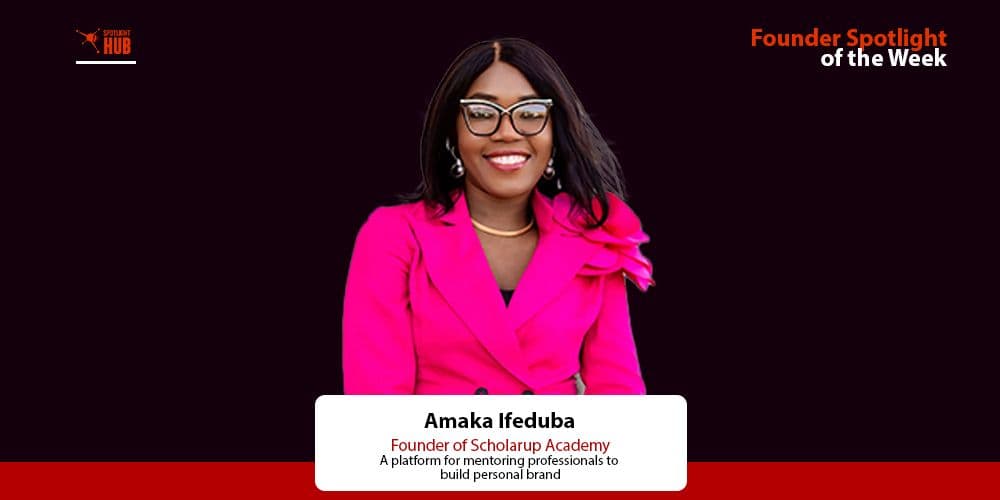
In our last interview, we had the privilege to have an academia, a coach, a mentor, and a founder, Dr. Amaka Ifeduba, a Nigerian scholar specializing in plant genetics and plant breeding, who has achieved significant success despite facing numerous challenges.
She overcame five years of rejections before gaining admission to study pharmacy in Nigeria, only to be redirected to plant sciences. Despite initial disappointment, she found a mentor who inspired her to excel in agriculture.
Dr. Ifeduba later pursued a PhD at Texas A&M University, maintaining a perfect GPA. She founded ScholarUp to help young professionals integrate personal branding with their academic and career paths. Her story highlights resilience, mentorship, and the transformative power of education.
From the labs of genetic crop improvement to lecture halls and mentorship bootcamps, Dr. Amaka Ifeduba is redefining what it means to be an academic in Africa. A specialist in plant breeding and genetics, she also wears the hat of a career coach, personal branding advocate, and youth mentor.
With years of academic excellence and personal growth under her belt, she has become a guiding light for students who need more than just lectures; they need direction.
Her journey, like many great ones, wasn’t linear. But every step was driven by her determination to educate, impact, and empower. In this interview, she talks about early rejections, rediscovering her path, and her passion for helping young people align their academics with purpose and self-worth.
"My journey began with my background in agriculture. I studied crop science during my undergraduate years, and during that time, I became fascinated with how we could improve the quality and yield of food crops.
That curiosity led me to specialize in plant breeding and genetics. I was passionate about research and the potential it had to change the food systems in Africa."
But beyond the science, something else tugged at her heart.
"Along the way, I started noticing a pattern: so many students were just going through school without any sense of purpose. They didn’t understand the opportunities available to them, nor did they see the bigger picture of what they could achieve.
I saw myself in many of them, especially during my early years. That’s when mentorship became more than a side interest; it became a calling."
"You see students with potential, but they don’t know what to do with it. That lack of clarity became something I wanted to fix."
"It started organically. I was using LinkedIn to share my academic experiences, tips for applications, insights from my research, and little reflections on growth. But soon, I began receiving tons of DMs.
People asked for help with scholarships, how to write better CVs, or how to find their academic path. I realized this wasn’t just casual interest. There was a huge mentorship gap."
Driven by these needs, she began organizing webinars, Instagram Lives, and structured group coaching sessions for students, especially those from underserved regions.
"I teach personal branding because I’ve seen firsthand how many brilliant people go unnoticed simply because they’re quiet or unsure of how to position themselves. I help them define their voice and show up with confidence."
"Academic success isn’t enough. If you can’t communicate your value, you’ll be invisible in the room."
"Yes, I’ve been rejected more times than I can count. I remember applying for international scholarships with so much hope, only to receive those painful 'We regret to inform you' emails. It was disheartening, but I had to push through."
She turned those experiences into fuel.
"Instead of staying discouraged, I started to ask, ‘What are successful candidates doing differently?’ I began reading their essays, studying how they structured their statements and how they showcased their achievements. I rebuilt my application strategy from scratch, and eventually, it worked."
"One rejection doesn’t mean you’re not qualified. Sometimes it means you need better strategy."
Now, she teaches students how to do the same, reviewing their applications, helping them position their achievements, and showing them how to tell their story.
"Clarity is always the first step. I ask a lot of questions. What are your goals? What are your values? What’s your ‘why’? Some people are shocked because they’ve never really reflected before. They just followed what others were doing."
Her approach is practical and deeply personalized.
"I help people identify whether they need further education, skill acquisition, or simply a mindset shift. Some of them want to study abroad, but they don’t even have a passport yet. We start from where they are."
Through her group sessions and one-on-one coaching, she addresses the emotional and strategic gaps most students face.
"Many people have dreams, but no plan. I help them build one."
"Because the world has changed. We’re in a digital-first era, and visibility matters. You can’t afford to be excellent and anonymous."
She adds that branding is not about pretending; it’s about showcasing your real value.
"People think branding means being loud or showing off. No, it’s about being clear and intentional about how you show up. Your bio, your tone, your content, it all tells a story. Why not make it a story that helps you?"
"We live in a digital world. If you’re not telling your story, someone else is controlling the narrative."
"The biggest challenge is time. Research has its own demands; there are deadlines, writing, and data analysis. Teaching requires preparation. Mentorship needs presence. Balancing all three is not easy."
She shares that she has had to learn how to be strategic with her calendar.
"I plan content in advance. I delegate when I can. I also communicate clearly with my audience so they understand when I’m unavailable. Most importantly, I’ve learned to say no when necessary."
"Even when I’m tired, a message from someone saying 'Thank you, I got the scholarship' reminds me why I do this."
"I want to scale impact. I’m working on a mentorship curriculum that schools can adopt. We need to stop leaving personal development and career clarity to chance."
She also hopes to collaborate with other academics and organizations to make mentorship accessible and institutionalized.
"I believe mentorship should be part of education. Every student should have access to someone who can guide them, not just academically but personally."
"We can’t keep letting students graduate without direction. It’s not just about knowledge anymore, it’s about direction."
Dr. Amaka’s journey to building Scholarup started from lived experience, one shaped by rejection, transformation, and the power of mentorship.
“What inspired me to start it is specifically what I benefited from mentoring myself,” she says.
“If you've gone through my story, you know I came from a very poor academic background, poor financial background. Meeting the right mentor made the difference.
It changed the course of my life, I went from a struggling student to graduating as best. That’s where the inspiration comes from, to pay it forward, to do for others what has been done for me.”
Scholarup was born to meet a very specific need: targeted academic mentorship for students, especially those navigating graduate school applications. The platform provides practical guidance, resources, and encouragement to help people take bold steps toward academic success.
“It fills a big role in academic mentorship, especially for those trying to get into graduate school. We help them, push them forward, and give them access to what I didn’t have at their stage.”
For Dr. Amaka, success is personal. It’s not measured in clicks or follower counts; it’s found in people.
“I measure impact mostly based on the transformation of the people I coach or mentor,” she explains. “When I see how people are when they come in, and how they change after going through our program, how things begin to take a better outlook for them, that has always been my motivation.”
Every student who finds clarity, wins a scholarship, or gains confidence becomes a reason to keep showing up.
Looking ahead, Dr. Amaka envisions a broader reach and deeper support, not just for scholars but also for professionals.
“We want to continue to expand on what we’re already doing, especially coaching people on personal branding and teaching them how to show up for themselves,” she says.
“We’re reaching more people, guiding upcoming graduate students, and also moving into corporate training and professional development.”
That next phase will involve building ScholarUp into a platform that doesn’t just support academia but also helps professionals find their voice and presence in the workplace.
Dr. Amaka’s advice is as real and raw as her journey.
“You really have to find the courage to start,” she says. “Don’t wait until you feel confident. Your confidence grows as your competence increases.”
She emphasizes that learning in public, failing in public, and being honest with your growth process is part of what shapes great founders.
“Be willing to learn and to fail. Don’t wait until you have it all figured out. Be open to learning. Look for mentors, people who’ve walked the path you’re trying to walk. It shortens the curve and helps you avoid unnecessary mistakes.”
“The journey itself is what makes you. So even when it feels like it’s not working, keep moving. Don’t stop showing up. Don’t be afraid of failure, it’s part of the process.”
A sneak peek into scholarup, a platform dedicated to demystifying grad school applications & positioning professionals for global opportunities through LinkedIn elevation.

Scholarup is more than a platform; it’s Dr. Amaka’s personal mission to guide future scholars.
Follow Dr. Amaka Ifeduba to learn more about her academic journey and mentorship programs, and also share more insightful tips from her channel on YouTube here.
You don’t want to miss this section of the newsletter.

Stewart Butterfield, co-founder of Slack, actually wanted to build a game, not a messaging tool. The game failed, but the team’s internal chat tool became Slack. Lesson? Sometimes, your “side tool” is the real main product. What you build while trying to build something else might just be the thing.
Until the next time, keep learning, Keep building, and Keep exploring
Category
Founder's Spotlight