Loading blogs...

By David A. Newdawn
28th May, 2026
Some teachers teach for money, while some teach for long-term impact and purpose. Joshua Oroge is one of the passionate teachers who have built a structured platform around what he loves to do, solving a long-term problem in ed-tech.
Intentional Builders,
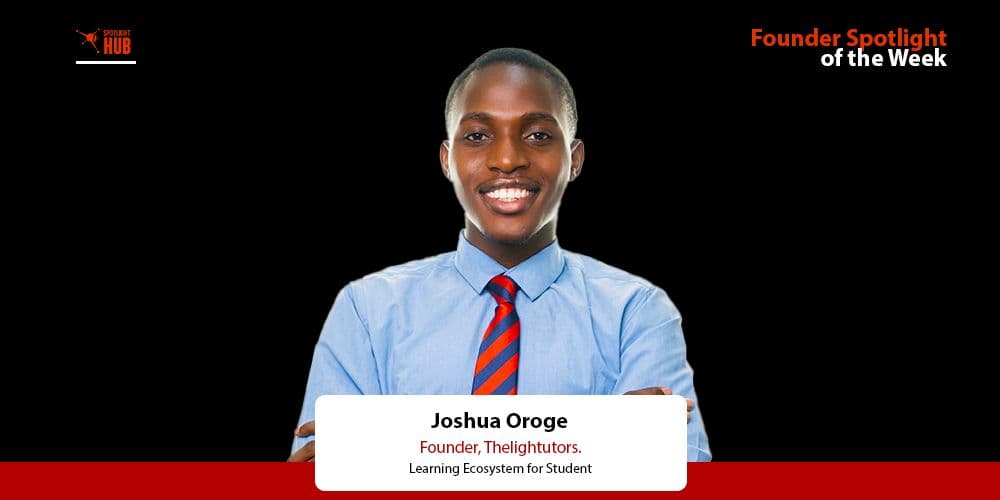
It’s another week to share a founder story, and this time around, it’s the story of a first-class graduate building a first-class platform, thelightutors, to provide qualitative education to every young student from the comfort of their home.
Meet Joshua Oroge, the founder of Thelightutors
Joshua’s journey did not begin with a clear plan to build an education company. It started with a moment many people experienced during the COVID lockdown, stillness, uncertainty, and too much unstructured time.
“It was during COVID,” he explains. “I was at home doing practically nothing, and I couldn’t let my life be wasted.”
That decision, to not remain idle, became the foundation of everything that followed. At that point, he wasn’t trying to solve a large-scale problem or build a startup. He simply wanted to be productive, to use his time in a way that created value.
So he turned to what he already knew, mathematics, teaching, and his ability to communicate clearly. It was a practical starting point, not a strategic one. But it was enough to begin.
With no sophisticated tools or structured system, Joshua began teaching using WhatsApp video calls. It was basic, sometimes inconvenient, and far from ideal. He had to switch between his front and back cameras just to explain concepts properly, often improvising as he went.
But despite the limitations, something important was happening.
Students were learning.
Parents were noticing.
And results were beginning to show.
It wasn’t perfect, but it was working.
That early phase highlights something many founders overlook: you don’t need perfect conditions to start. You need willingness, consistency, and the ability to work with what you have.
The real turning point came when Joshua was introduced to Zoom. With features like a digital whiteboard and more structured teaching tools, his sessions became more effective and engaging.
But more importantly, it changed his reach.
What was once limited to people within his immediate environment began to expand. Students from different locations started joining. Some referrals even came from outside Nigeria. What began as a small effort to stay productive was gradually becoming something with structure and demand.
Parents began requesting additional subjects.
Students began referring their friends.
The workload increased.
And at that point, it became clear this could no longer remain a one-man effort.
By 2022, Joshua made a critical decision: to build beyond himself.
He began hiring tutors, but not in a casual or reactive way. “I didn’t just bring my friends,” he explains. “There was an interview process. We checked for character, not just skill.”
That distinction mattered.
He wasn’t just building a team to handle workload; he was building a system that required trust, responsibility, and alignment. Skill alone wasn’t enough; attitude and character were just as important.
At the same time, he began formalizing the business.
Personal and business finances were separated.
Roles were defined.
Processes were introduced.
This marked the shift from a side activity into an organization.
And at the center of that transition was a principle he holds strongly:
“The company has to survive without the founder.”
As the team grew, Joshua became more intentional about leadership.
He adopted a servant leadership approach, where the focus is on enabling people rather than controlling them. For him, leadership is not about authority; it’s about responsibility.
He believes that when people feel valued and trusted, they perform better and take ownership of their roles. That belief is reflected in how the team operates today.

Managers are not expected to simply report problems.
They are expected to think, analyze, and come with solutions.
This shift in mindset has improved how decisions are made within the company, making the team more proactive, accountable, and aligned.
Beyond leadership, Joshua has been deliberate about building operational systems.
The Light Tutors is not run as a loose tutoring network. It is structured around tracking and improving learning outcomes.
They monitor:
“Data tells us a lot,” Joshua explains. “We can see where a student started and where they are now.”
This level of structure transforms the service from simple tutoring into something more measurable and intentional.
It’s not just about teaching.
It’s about ensuring learning actually happens.
As the company has grown, Joshua’s thinking has evolved beyond tutoring.
He is now focused on building what he describes as a “delightful learning ecosystem.”

This goes beyond delivering lessons. It is about creating an environment where every participant benefits:
Students enjoy the process of learning.
Parents see clear and measurable results.
Tutors feel valued and fulfilled.
And the system itself continues to improve over time.
The long-term ambition is to scale this model beyond its current reach, expanding into new markets while maintaining the quality and experience that define the platform.
It’s a shift from service delivery to system design.
Joshua described three founder situations, pre-start hesitation, starting without full readiness, and founders who become stuck; and advised people to begin before they feel fully ready and to validate ideas by solving genuine problems. He urged founders to think beyond short-term survival and to adopt a vision that is “bigger than you” to shift trajectory and broaden impact.
He recommended surrounding oneself with active peers and mentors as practical support when stalled.
New founders should start before they feel fully ready and iterate as they go
Founders who feel stuck should confirm they are solving real problems rather than chasing random ideas
Thinking of ventures as “bigger than you” can change long-term trajectory and impact
Surrounding yourself with active, further-along peers is a practical way to overcome stalls
Joshua cited Isaac Oladimeji as an example mentor who provided operational support and motivation during early events, illustrating the value of experienced peers for scale and encouragement. He tied mentorship to spiritual grounding, advising founders to lean on the grace of God rather than operating on personal strength alone.
Joshua credits faith and grace as core supports for sustaining founder work
What Joshua has built is not just an education platform.
It is a system that grew from
It is a reminder that building doesn’t always start with a grand vision.
Sometimes, it starts with a decision not to waste time.
And over time, that decision becomes something much bigger than you imagined.
Building anything meaningful takes clarity, patience, and the courage to keep showing up even when things are uncertain.
At TheSpotlighthub, we’ll keep sharing stories and insights from people doing the work.
If you missed the previously spotlighted founder, you can read the story of the last founder spotlighted here.
Interview with Mike Brainz, founder of Golden Harvest acres
Until next time, keep building what matters.
The Spotlighthub Team
Category
Founder's Spotlight